

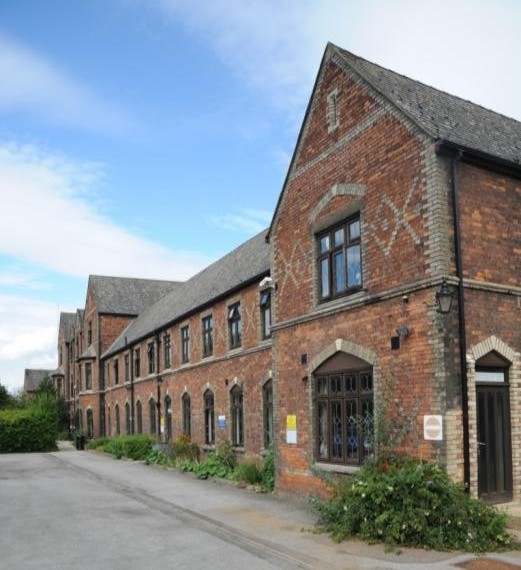
Large south-facing building of red brick with white brick detailing under a slate roof, the whole set back from the road. The central section has 3 storeys and loft and 5 gables, the end 2 gables projecting slightly and with canted bays at ground- and 1st-floor levels. Central doorway is large & arched, all windows have been replaced with modern lattice casement windows. Attached to both east and west are 2 symmetrical wings of 2 storeys and loft ending in a projecting gable with large windows & attic. Wings each have 10–11 windows, one of which each side is converted to a door. The whole building has a projecting stone string course.
Designed by Medland and Maberley (Pevsner) and built in 1856 for £1,400. Formerly St James Workhouse, replacing the original in St James Chapel which collapsed in 1854. This more homely style represents a new way of thinking about workhouses (information from English Heritage’s thematic study of workhouses).
(Nationally) important local historical association: R Vaughan Williams visited here in 1905 to record traditional songs from former fishermen and seamen. Some appear in his orchestral works and one (not from the Workhouse) became the hymn tune King’s Lynn when chosen by RVW for his English Hymnal.
Category: Built environment
Sub Category: Architectural interest
Alfred Maberley was a London-born architect who went into partnership with the King’s Lynn Cruso’s, who were surveyors. Together they designed St John’s National School 1852 and the Athenaeum (Lynn Advertiser 9th April 1853) (demolished when a new post office was built in 1938) and went on to design the very similar but larger Corn Exchange; by the time it opened in 1855, the partnership had been dissolved and Maberley was now part of Medland and Maberley of Gloucester (Lynn Advertiser 13th January 1855). The new partnership also designed the King’s Lynn Savings Bank (St James Street) in 1859 (Lynn Advertiser 21st May 1859).
< Back to map